Showing posts with label director. Show all posts

Tuesday, September 2, 2014

LUNA: 5 Question Interview with Director Dave McKean


Dave McKean works in many mediums--comics (most famously his covers for The Sandman); illustration; painting; collage, music, photography and film. Aside from his previous feature film, MirrorMask (2005), McKean has directed two shorts, N[eon] (2002) and The Week Before (1998). He directed the film adaptation of the National Theatre Wales' The Gospel Of Us (2012). He's done design for Harry Potter And The Wizard Of Azkaban (2004) and the titles for Neverwhere (1996). Now he brings Luna to TIFF.  McKean was kind enough to answer a few questions. ~ Carol Borden

Where some of your other films are quite stylized and, in the case of The Week Before, almost expressionist, Luna combines fantastic, expressionist and animated elements with more naturalistic ones. What are some of the challenges in blending the fantastic with the naturalistic?

I think it's easier to sustain a very stylized form of storytelling for a short film. I like stories that exist both in the naturalistic world and in our imaginative lives, films are so immersive in that sense, we can explore how our characters think and dream, as well as how they exist in the real world. I think it's very easy to just go down the rabbit hole, or through the door to Narnia or Oz. I'm interested in the parallel narrative of our fantasy lives, or as Dean puts in it Luna, our imaginative lives. How the moment of 'now' that is palpably real, is surrounded by our memories, our dreams and hopes, the stories and connections that our brains make as we navigate the world--a universe of fantasy, or unreality, or surreality. I'm keen to explore this very human experience, how our minds create our own realities--a blend of fact and interpretation of fact.

What do you think fantasy, surrealism and magical realism's strengths are in reflecting and understanding people's lives?

They function like a lens I think. They allow us to see our everyday joys, fears, dramas, tragedies, triumphs in terms or story, or even poetry. Our brains tend to join the dots, make connections. We create dramatic arcs by seeing the relationship between things, but this is our brains creating stories. So these associative images magnify and intensify our experience of the world. They create meaning.

As someone who's worked with illustration, painting, collage and photography, what are some of the differences for you in working with a moving medium rather than a static one?

In some ways they are very similar. I'm always thinking about story, and the development of ideas or images, so with all of these media, I'm simply trying to communicate the feelings and ideas in the story or characters in the most appropriate and effective way. Film gives me live actors, editing, music, sound, a huge and powerful toolbox to play with. If there is a problem for me, it is that film gives me too much. There is less room for the audience to add their side of the conversation. The reason I love comics is that they DON'T move, and there is NO sound. As a creator I have to evoke those elements in the drawings and writing, and the reader has to create those elements in their own minds. Reading a good comic is a creative act. Watching a film is often a more passive experience, and since I'm interested in engaging that conversational aspect of creativity, I'm trying to find ways of achieving that in my films.

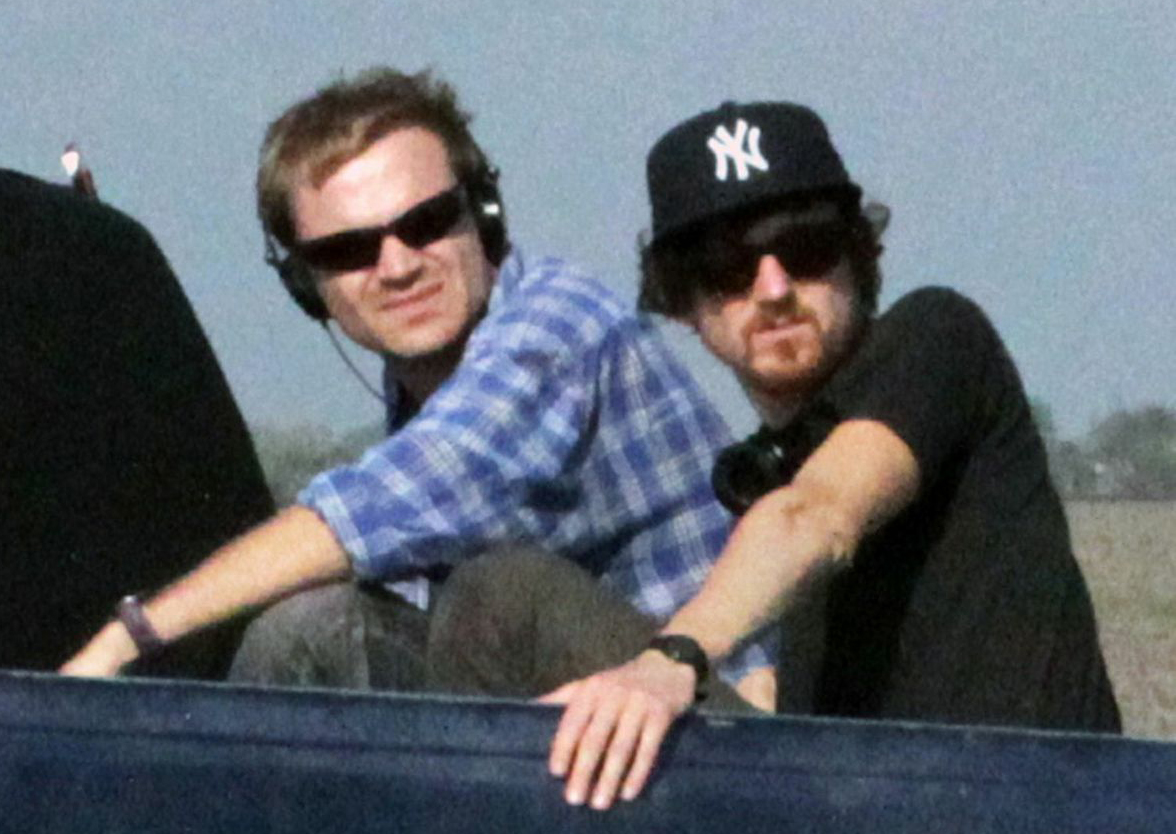
McKean working on the set of Luna

Does your illustration, collage and painting inform your filmmaking, and, if so, could you share how it does?

They all talk to each other. Sometimes the things I learn making paintings or drawings--composition, colour, expressionism, texture--can directly influence the making of a film. Sometimes it's great that they are different, and simply taking a break from one medium to spend time with another, recharges the batteries and I feel refreshed.

Who are some of your favorite filmmakers and how have they influenced you?

So many--there are so many extraordinarily creative and brilliant technicians and actors working in the field. The filmmakers I really love are the ones that let me look through their eyes for a while. they have an aesthetic and social point of view. And there have been so many of these. I love the silent era because you can see the rules being written, the grammar of film being created. Murnau, Dreyer and Sjöström I love, as well as many of the Ufa films created in the 20's. Most of my films (all of them?) are in some way love letters to the silent era. I love directors and animators who take complete control of their film world; Svankmajer, Trnka, the Quays, Maddin, Lynch, Fellini. I love the great masters of time and landscape--Tarkovsky, Angelopoulos, Sokurov, Lopushansky. I remain a huge Woody Allen fan, despite the rough years. I love the group of truly modern filmmakers who have really got to grips with the digital realm; Jonze, Gondry, Glazer, Taymor. And I love Lars von Trier--he is, and I never use this word, a genius. I could go on for hours. Oh, and Bob Fosse--my favourite film is All That Jazz. Oh, and Michael Powell.

Okay, that will do.

LUNA screening times:
Sat., Sept. 6, The Bloor Hot Docs Cinema 6:30 PM
Mon., Sept. 8, AGO Jackman Hall 9:00 AM
Sun., Sept. 14, Scotiabank 9 8:45 PM

Monday, September 1, 2014

OVER YOUR DEAD BODY: Takashi Miike TIFF Retrospective


Over Your Dead Body is Miike's first movie to play the Vanguard program, but Miike's films have been screened at TIFF before--in the Midnight Madness program. And Miike has met Vanguard/ Midnight Madness programmer Colin Geddes' parents. True fact.

Takashi Miike is insanely prolific director with 94 credits at IMDb since he first began directing in 1991. A good part of Miike's career has focused on genre-bending, weird, funny and extremely violent films. Miike plays successfully with generic conventions and blows them way past camp into The Miike Zone. But recently he's been making art house films strongly influenced by classic Japanese cinema.

Fudoh: The New Generation (1997) was the first film Miike screened at TIFF and Midnight Madness. Son of a powerful and violent Yakuza boss, Riki Fudoh (Shosuke Tanihara) makes his high school his turf and takes revenge for his brother's death. He begins assassinating yakuza members with the help of his fellow students, including his female assassin/bodyguards, one of whom shoots darts from an unexpected place--but not all that unexpected because this is Miike.

Say what you will about yakuza bosses, they do love to laugh.

Miike returned to Midnight Madness with City of Lost Souls , aka, The Hazard City (2000).  Brazilian-Japanese gangster Mario (Teah) and illegal Chinese immigrant Kei (Michelle Reis) are on the run from Triad boss Ko (Mitsuhiro Oikawa) and on their way to Australia. But there are complications including a little girl and a suitcase full of cocaine. City Of Lost Souls also captures some of the experience of being marginal and other in Japan.

Do not confuse City of Lost Souls with City of Lost Souls
even though there is star-crossed love in both. Thank you.


In 2001 Miike returned to Midnight Madness with his harrowing, brutal, gorgeous and darkly comic film, Ichi The Killer. Ichi (Nao Ōmori) is a hitman and a sadist who dreams of a willing victim while taking contracts from Jijii (MM Alumnus Shinya Tsukamoto, director of Tetsuo (1989) and Nightmare Detective (2006)). Meanwhile, the flamboyant and extremely masochistic yakuza lieutenant Kakihara (Tadanobu Asano) searches for the man who killed his boss. Also, really, really brutal, but somehow Miike successfully subverts the homoeroticism of so many yakuza and crime movies.

Oh, Tadanobu Asano, you're so dreamy... Wait, what did you do to your face?!

I remember Colin warning the Midnight Madness audience that Gozu (2003) was a departure from Miike's previous yakuza movies. He told us it was weird. He told us that there was lactation involved. And he was right. Gozu--or my preferred title, Yakuza Horror Theater: Cow's Head--is deeply weird and almost feverish. In Gozu, yakuza soldier Minami (Yuta Sone / Hideki Sone) is supposed to drive his yakuza brother and friend Ozaki (Shō Aikawa) to Ozaki's execution. On the trip, Ozaki disappears. Minami begins searching for Ozaki in what might be a descent into insanity or a series of almost mythical phantasmagoric labors.

The Minotaur was not expecting company.

Then there are three films I'm quite fond of, but fans who were looking for dependable wtf yakuza films often do not enjoy so much.

Zebraman (2004) took Midnight Madness by surprise with its story of Shinichi Ichikawa (Shō Aikawa) a school teacher who dreams of being Zebraman, a television masked superhero whose show was canceled after only a few episodes. Then, one day, aliens invade and Japan needs Zebraman. Striping Evil! Zebraman is a children's film, but it is a Miike children's film.

What am I doing? Why do you ask?

The Great Yokai War (2005) is a children's film and a homage to Daiei Studio's fantasy/horror trilogy: Yokai Monsters: Spook Warfare (1968); Yokai Monsters: One Hundred Monsters (1968); and, Yokai Monsters: Along With Ghosts (1969). In The Great Yokai War, Lord Yasunori Kato (Etsushi Toyokawa) uses all the power of his misanthropy and harnesses the resentment of discarded objects to create an angry demon. Only Tadashi (Ryunosuke Kamiki), a little boy chosen to be the Kirin Rider at a local shrine festival, can stop him--with help from yokai spirits and creatures like a kappa, the River Princess, a tengu and the Azuki Bean Counter. I have a sensitivity to storylines about chosen boys, but I didn't mind this at all. And yokai just make me happy.

Yokai always make up for Chosen Ones.

Sukiyaki Western Django (2007) is Miike's first sort of chanbara (Japanese swordfighting/samurai) film as well as his first Western. Plus, an adaptation of Django (1966). And his first adaptation of Shakespeare. And his first English language Japanese movie. As Miike told the audience in a specially filmed message shown before Sukiyaki Western Django: "Of all the English language Japanese Westerns in the festival this year, I hope this will be one of your favorites."

Oh it is.

Yoshitsune and the Genji Clan are casually homicidal

13 Assassins (2010) was Miike's first film to screen outside of Midnight Madness at TIFF. It's Miike's remake of Eiichi Kudo's classic 1963 film, Thirteen Assassins. Set during the late Tokugawa Shogunate, thirteen samurai are assigned to assassinate a vile lord who abuses his authority and is, unfortunately, the Shogun's nephew. Miike follows Kudo's original fairly closely--sometimes almost shot for shot--but adds some Miike touches including some digital effects and some elaboration of the lord's villainy. Once you've seen both versions, you might be interested in this comparison of the movies at Wildgrounds.

Seriously, this is a Miike film.

And Miike remade another chanbara classic, Masaki Kobayashi's Harakiri (1962) with Hara-Kiri: Death of a Samurai (2011). Kabuki star Ebizo Ichikawa takes on the role Tatsuya Nakadai played in the original. A poor samurai (Ichikawa) approaches a wealthy lord for permission to commit suicide at the lord's estate. He is told the story of a samurai who had done the same, and, having pawned his sword, was forced to disembowel himself with a bamboo practice sword. Miike focuses more on melodrama, violence and gore, but not nearly as much as many of his other films. In a very Miike touch, Hara-Kiri played Cannes in 3D. And it's scored by Ryuichi Sakamoto.

As bad a situation as it looks.
Ebizo Ichikawa returns in Over Your Dead Body as Kousuke Hasegawa, the actor who portrays Tamiya Iemon in the play-with-a-film production of Yotsuya Kaidan. Miike's blurs the line between reality and fantasy, theater and mundane life as a theater company rehearse an adaptation of Yotsuya Kaidan, a story of betrayal, murder and supernatural revenge. While fans of Miike's extreme cinema might find it too restrained, it is a stunningly gorgeous film.

Ebizo Ichikawa as Iemon wearing Tatsuya Nakadai's 'do.

OVER YOUR DEAD BODY screening times:
Thurs., Sept. 11, Ryerson 6:00 PM
Fri., Sept. 12, The Bloor Hot Docs Cinema 9:00 PM
Sat., Sept. 13, TIFF Bell Lightbox 2 6:30 PM

Friday, September 13, 2013

A FIELD IN ENGLAND: 5 Questions with Director Ben Wheatley


Well, kids, it's that time of year again. Time for our annual 5 Questions with Director Ben Wheatley, that is! Siân had a lot of fun asking Mr. Ben Wheatley questions last year about his Vangurd film Sightseers and now she's back with round two for Wheatley's Wavelengths film, A Field in England.

//

SM: Watching A Field in England, I couldn't help but draw comparisons to Barry Lyndon and Witchfinder General. Did either of those films inspire yours? What drew you to doing a period piece in the first place? 

 BW: All Kubrick is an inspiration. Witchfinder is a similar period but not really an inspiration. History drew me to the period. It's a fascinating time.

SM: Just being on set--stuck in that field--must have been a surreal experience. Were there ever times when you started to doubt you'd bring it all together?

BW: No. Not really. It was a pretty good experience. I tend to be pretty happy when I'm shooting.

SM: In the last few years black and white films have experience quite a renaissance; films like The White Ribbon, Nebraska, Frances Ha, Blancanieves, and Joss Whedon's Much Ado About Nothing, have embraced this aesthetic. Could you share some insight on why you think filmmakers are being drawn to this?

BW: For me Black and White makes you look at faces and texture. It funnels the amount of information the viewer receives. I can't speak for other film makers.

SM: The soundscape and music in the film are stunning and pretty much a character in their own right. Although this is a period film, the music is decidedly anachronistic, but it really enhances the films' otherworldliness. Did you play a large part in this process or was it all the invention of the composer?

BW: I play a large part in the music. I worked closely with Jim Williams on this score. I'm not a musician though. We talk about the score a lot then he demos it. I get the demos as stems then I make a rough mix of what I like from the stems. The score is then created from that.

SM: So far, each of your films has been wildly different than the last and often gives the audience an unexpected experience (for example, Sightseers starts off as a quirky British road comedy and evolves in to Natural Born Killers with sweaters). Has this been a conscious decision?

BW: Making an experience is a conscious decision. Every frame of a film is deliberated on. You see the films as different from each other. I see them as too similar to each other. I'm trying not to make the same film again and again. But it's hard.

//

We here at the Vanguard Blog are some of Wheatley's biggest fans and we're confident that whatever he does next will be mind-alteringly awesome. We just hope it's out in time for the Festival next year so we can have our third annual 5 Quesetions with Ben Wheatley. In the meantime, don't forget to check out A Field in England.

A FIELD IN ENGLAND Screening Times:
  • Friday, Sept 13, 9:00 PM RYERSON THEATRE
  • Saturday, Sept 14, 9:00PM TIFF BELL LIGHTBOX 3


Sunday, September 8, 2013

SOUL: Profile of Director Chung Mong-Hong


Chung Mong-Hong (aka, Chung Mang-Wang) has written and directed five films: Doctor (2006), Parking (2008), The Fourth Portrait (2010), and the segment, "Reverberation" in the anthology celebrating Taiwan's Centenary, 10 + 10 (2011), and now Soul.

Born in Pingtung, Taiwan, Chung studied information technology engineering at National Chiao Tung University and film as a graduate student at the Art Institute of Chicago. In an interview with Ho Yi at The Taipei Times, Chung shares what inspired him to become a filmmaker:
 I had lived in the countryside in Pingtung until high school. Going to a movie was the ultimate form of entertainment. We saw lots of Bruce Lee (李小龍) and Michael Hui (許冠文) films. I was particularly fond of the James Bond movies because they were like pornography for us kids. [He laughs.]

In high school I had a chance to see Nagisa Oshima’s Merry Christmas, Mr Lawrence. There is one scene where David Bowie kisses Ryuichi Sakamoto. It got me to start thinking, “Wow, movies can show so many special things, things I don’t understand.”

He has directed over one hundred commercials, but in an interview with Ryuichi Sugiyama at the Tokyo International Film Festival's blog, he indicated a desire to move away from commercial film-making.

When shooting Parking, I had tried not to fall into the habit of making commercial films, which ended up in vain. So with that in mind, in making The Fourth Portrait, I took the utmost care in simple film making, but I don't think I am thoroughly successful in that sense. My assignment is to get rid of the habit of making commercial films....I think my experience in TV commercial making is an obstacle when making movies. The fact that most of the directors with TV commercial career are not making a big success in Taiwan might be the proof.
He told The Taipei Times that he decided to start his feature career with a documentary, Doctor, "Documentary filmmaking is the opposite of commercial filmmaking." And elaborated:

You must divide the two. Have you seen any movies made by television commercial directors? Basically they all fail. It hurts me to see my colleagues fail. The problem is if you look at a 100-minute project with an eye trained for a 30-second ad, you are bound to be crushed.
Styles and forms are not sins in and of themselves. But the most important thing is to return to the basic question: what do you want your audience to see? It would be wrong if a director plays with a [visual] style thinking, “Wow, it’s cool!” and repeats it for 100 minutes. As a commercial director, you have to give up what you excel in — images and combinations of images.

Doctor follows a Taiwanese-American doctor who loses his son to suicide and a patient to cancer.


Parking starts with a parking dispute and escalates into much more. It stars Chapman To, Chang Chen, Jack Kao and Kwai Lun-Mei and frequent Chung collaborator, Leon Dai, who also appears in Soul.


And where Parking was influenced by the paintings of Edward Hooper, The Fourth Portrait features art made by Felix, the boy who committed suicide in Doctor.


However, as Chung tells Ryuichi Sugiyama at the Tokyo International Film Festival's blog:

Doctor is a documentary, but I have a special feeling for it because it is my first feature film. It is very true that the picture drawn by Felix had a great influence in making the The Fourth Portrait, but I am thinking of saying goodbye to Felix after this film. I’ve made up my mind to get over his past and go on to a completely new direction for the next film....It is going to be a very scary horror film featuring schizophrenia.

 Make sure to read both interviews and then see what new direction Chung has taken with Soul.

SOUL Screening Times:
Monday, Sept 9th, 6:15 PM SCOTIABANK 11
Tuesday, Sept 10th, 6:15 PM SCOTIABANK 3
Saturday, Sept 14th, 12:00 PM SCOTIABANK 10

Wednesday, September 4, 2013

CELESTIAL WIVES OF THE MEADOW MARI Director Profile: Alexey Fedorchenko


Director Alexey Fedorchenko began his film career in a most peculiar way: by not. Initially earning a degree in economics in his hometown of Yekaterinburg, Russia, it was years later that he started working in the documentary facility of Sverdlovsk Studios and then in the screenwriting department of the Russian Institute of Cinematography. So it only makes sense that Fedorchenko began his career making short documentaries. 


For his first feature film, First on the Moon (2005), Fedorchenko combined his experience with documentary with the fantastical to end up with a "mockumentary" about the the "first" landing on the Moon in the 1930s by the Soviets. Shot in gorgeous black and white, Fedorchenko described the story as "something of an homage to the generation of our fathers and grandfathers, including their honesty, their genuine belief in an ideal". The film was celebrated by critics both in Russia and around the world and went on to win a handful of awards, including one from the Venice Film Festival. Two short clips from First on the Moon can be viewed here


Fedorchenko has been quoted as saying that "all fictional films are fairytales, fairytale for adults, done in different genres." Silent Souls (2010), Fedorchenko's second feature film, holds true to this. Silent Souls was a road movie based on short story and rich in the folklore and traditions of the Meyra people. Silent Souls impressed countless critics, including Roger Ebert, who commented that the "profound and immensely touching film in only 75 perfect minutes achieves the profundity of an epic." It was considered a frontrunner for the Golden Lion at the Venice Film Festival and went on to win the Golden Osella for Cinematography. You can watch the trailer below: 


Not quite ready to leave Russian folklore behind, Fedorchenko further explores this theme in Celestial Wives of the Meadow Mari, screening at this year's Toronto International Film Festival. Working again with the same screenwriter from Silent Souls, Fedorchenko wove together 23 vignettes about love, beauty, and female sexuality. Words really don't even begin to describe this magical film, so we urge you to watch the trailer. Even if you've watched it already, watch it again. You know you want to:


CELESTIAL WIVES OF MEADOW MARI Screening Times:

  • Wednesday, Sept 11th, 7:00 PM TIFF BELL LIGHTBOX 4
  • Thursday, Sept 12th, 9:15 PM TIFF BELL LIGHTBOX 2
  • Saturday, Sept 14th, 9:30 AM SCOTIABANK 8

Tuesday, September 3, 2013

WE GOTTA GET OUT OF THIS PLACE Director Profile: Simon and Zeke Hawkins


That we don't have prior feature films to discuss when talking about Simon and Zeke Hawkins should not be reason to worry. In fact, we can't really think of a better form of praise than having one's first feature film premiere at the Toronto International Film Festival. And in the best--in our humble opinion--Programme as well. (Ahem, Vanguard, ahem.) 

The directors (and brothers, if the same last name didn't tip you off) will be premiering We Gotta Get Out of This Place at this year's Festival. The film is being described as a "tight, twisty, Texas-set nouveau noir" with a nod to pulp crime legend Jim Thompson. And if that wasn't bad-ass enough, Jonathan Keevil (of Bellflower fame) worked on the score. Colour us impressed. 

If we travel back in time a few years (Figuratively, because we only wish we had a time machine, but who really needs one when you have the internet, right?), we see that Zeke directed a short film, Equestrian Sexual Response, that premiered at the 2010 SXSW Film Festival. Don't let the title make you nervous; Moviegeeks.com called it "a sweet and tender film that handles the subject matter of sexual discovery with tact and respectful insight" and went on to praise the cinematography ("sublime"), original music, and the lead actresses' performance ("compellingly realistic, poignant and heartbreaking"). It's no surprise that the short went on to win the 20110 SXSW Special Jury Prize, as well as being featured in a handful of other film festivals. You can watch the trailer for Equestrian Sexual Response below:


The brothers have also gained praise for their The Godfather Musical series, with the "Ode to Fredo" chapter screening at a handful of festivals and picking up a couple of awards as well. This author is rather ashamed to admit that she has never seen the Godfather films, but she's quite certain that the "Ode to Fredo" is brilliant. She just doesn't, uh, know who Fredo is. See for yourself: 


And if you're all, "The Godfather isn't really my cup of tea", that's cool. There is The Braveheart Musical instead. You can check that out on Simon and Zeke's website, along with proof of Simon's prestigious Excellence in Dance award.

So, maybe we're a little (just a little) sad that Zeke and Simon Hawkins have appeared to have left the world of hilarious musicals and dance behind (or have they?!). That being said, we are beyond eager with anticipation to see their first feature film, and first foray into the nouveau noir, thriller genre. 


  • Saturday, Sept 7th, 6:45 PM THE BLOOR HOT DOCS CINEMA
  • Sunday, Sept 8th, 4:00 PM SCOTIABANK 4
  • Sunday, Sept 15th, 9:00 PM SCOTIABANK 10

Sunday, September 9, 2012

iLL MANORS: Director Ben Drew's Music Career


Ben Drew is the director of the upcoming Vanguard film ill Manors. He is also a chart topping rapper and singer-songwriter, going by his artist name, Plan B. Oh, and acts as well. Some people just have all the talent. Sheesh.

Plan B recorded songs and performed from 2005 to 2008, releasing mixtures and remixes which helped him to gain notoriety in the UK. His debut album, Who Needs Action When You Got Words, was released in 2006 to critical acclaim. In 2009, Drew appeared in the film Harry Brown. He collaborated with the group Chase & Status on a song that appeared on the soundtrack, "End Credits", which became his first Top 10 hit. 


Plan B's second album,The Defamation of Strickland Banks, was released in the spring of 2010. His first album showcased his rapping abilities, and this second album went in a different direction as a concept album about a soul singer. You might be rolling your eyes at the thought of a rapper turned soul singer, but Plan B impressed critics by actually being able to sing (a sometimes rare talent in the music industry these days) and the album got positive reviews. The lead single "Stay Too Long", was also a Top 10 hit, as was the second single, "She Said". 


After successfully taking over the British music scene, Plan B decided to become a world famous tap dancer. Okay, not really. We doubt we'd be able to handle it if Drew added "dancer" to his impressive list of credentials anyway. Instead, after his second album, Drew started focusing on his directing career. But, don't worry, he still managed to create all new music for his first feature film, ill Manors, with the songs acting as narration. The soundtrack alum was released earlier this spring and the single, "ill Manors", is--you guessed it--another chart topping hit. 


You're probably already downloading all of Plan B's music from iTunes, so the only thing left to do is get your ticket to an upcoming screening of ill Manors. How about tonight's? What better way to spend a Sunday evening, right? Bangarang. 

ILL MANORS Screening Times:
Sun., Sept. 9th, 9:00 PM BLOOR HOT DOCS CINEMA
Tue., Sept. 11th, 4:15 PM SCOTIABANK 4
Sat., Sept. 15th, 9:30 PM SCOTIABANK 4

Friday, August 31, 2012

BLONDIE Director Profile: Jesper Ganslandt


Director Jesper Ganslandt is only on his third feature film and he's already being hailed as one of the "strongest names in the new Swedish wave of young directors." Colour us impressed; we haven't even put on pants or had breakfast yet. Whatever they're putting in the water over there in Sweden: please, keep it up.

Ganslandt grew up in a small town called Falkenberg before moving to Stockholm. There, he started a production company called Fasad, which has been responsible for producing all of his films. In 2006, Ganslandt's first feature film, Falkenberg Farewell, premiered at the Venice Film Festival and then the Toronto International Film Festival. The film was a love song to his hometown--a means to say "goodbye". He wrote and co-starred in the film along with his actual friends. A nostalgic, bittersweet coming of age story, the film was said to be "less a narrative movie than an immersion in somebody else's time and place." The film went on to be nominated for four Guldbagge Awards (including Best Film). We've posted the trailer below, which will be most enjoyed by those of you who can either listen in Swedish or read in French. (Or maybe you're a keener and can do both. But who asked you.)


The Ape is Ganslandt's second feature film, premiering at the 2009 Venice Film Festival and then shown as part of the Vanguard programme (AKA, the best programme, ahem) at the 2009 Toronto International Film Festival. The film follows a character as he wakes up covered in blood and then goes about his day as usual. Huh, makes sense--wouldn't want to be late for work, right? Part minimalist thriller, part puzzle, the audience follows the man throughout the movie trying to figure out what terrible thing has occurred. Of the film, the Guardian proclaimed, "…in Jesper Ganslandt, Sweden has a new star director."


This year, the Toronto International Film Festival is thrilled to welcome Ganslandt back with the premier of his third feature film, Blondie. The film follows three sisters reunited at their mother's home for her seventieth birthday. But don't expect any happy-fun-time balloons and confetti at this party; Ganslandt weaves together an anxious, melodramatic weekend, with family secrets exposed and old wounds ripped open. The  trailer is below, along with the screening times. 


BLONDIE Screening Times:
Mon., Sept. 10th, 9:45 PM SCOTIABANK 2
Wed., Sept. 12th, 12:00 PM BLOOR HOT DOCS CINEMA
Fri., Sept. 14th, 6:15 PM SCOTIABANK 3

Thursday, August 30, 2012

Director Profile: Michel Gondry (THE WE AND THE I)


We were puzzling over the very best way to introduce our Director Profile of Michel Gondry (the dude spying on you--yes, you--in the above photography) and we were at a lack for words. This inventive director needed a likewise introduction. Something spectacular. Something punchy. Something that sums up the question, "Who is Michel Gondry? No, really." Ahem:


"Who is Michel Gondry?" Well, for starters, he is a man who can solve a Rubik's cube with his nose. Why solve 3-D mechanical puzzles with your hands when you can use your nasal cavity, is what we always say. When Gondry isn't busy being the obvious hit at parties, he makes fantastical, awesome films. Not with his nasal cavity. (We think?)

Gondry started off his career in the world of music videos. He's frolicked around in the woods with Bjork and a giant stuffed bear, changed things with Sheryl Crow, turned the White Stripes into building blocks, cloned Kylie Minoque, and danced with Flight of the Conchords--just to name a few. Gondry's unique and inventive storytelling style and camera techniques also led to his success in directing commercials. Remember that Gap holiday commercial that you maybe--okay, definitely--hated by the end of the holiday season? Gondry also directed commercials for Smirnoff, Air France, Polaroid, and Levi's.

In 2001, Gondry made his feature film directorial debut with Human Nature, a comedy written by Charlie Kaufman. The film explores topics like sex, human nature, and a very hairy and naked Patricia Arquette. Roger Ebert applauded the film's "screwball charm" and "manic whimsy".

2004's Eternal Sunshine of the Spotless Mind ("Hi, Joel. No jokes about my name.") is probably Gondry's most popular film to date. Gondry teamed up again with Kaufman and the film won the Academy Award for Best Original Screenplay. The film presented the fascinating question of: if you could erase someone from your mind, would you? Or, rather: can you? And people have been flocking to Montauk Beach in February ever since.

Artist rendition of Gondry performing his nasal cavity hijinks at a fancy-pants soiree.
Gondry followed up with The Science of Sleep in 2006, which he also wrote. A fantastical seemingly sideways-moving story that the New York Times said, "is so profoundly idiosyncratic, and so confident in its oddity, that any attempt to describe it is bound to be misleading."

Be Kind Rewind (2008), Gondry's fourth feature film is an underrated comedy about your typical magnetized dude who accidentally erases all the tapes in a video store (don't you just hate when that happens?), and hilarity--Gondry style--ensues. (If you're under the age of 12, you might not know what a "video cassette" or "VHS" is and for that we are truly sorry. We also feel old.) Not only is the film hilarious, but it also introduced us all to the concept of "Sweded" films. Huzzah.

Gondry is back at the 2012 Toronto International Film Festival with The We and the I. If you've ever wanted to know what a busload of Bronx teenagers would look like through the eyes of Michel Gondry, then this is the film for you. Because that is what it is about. Early reviews from Cannes are positive, with the Hollywood Reporter saying, "…the film has a scrappy charm that springs organically from the characters and their stories." If only Gondry could have directed all of our high school bus rides home, right?

Below is the trailer and screening times for The We and the I.


THE WE AND THE I Screening Times:
Fri., Sept. 7th, 6:45 PM SCOTIABANK 1
Sat., Sept. 8th, 11:45 AM CINEPLEX YONGE & DUNDAS 6
Sat., Sept. 15th, 3:00 PM SCOTIABANK 1

Tuesday, August 28, 2012

Director Ben Wheatley: Viral, Commercial, TV Works


When we mentioned in a previous post that Mr Ben Wheatley has won at both the Internet and TV, we simply made the statement and moved on. Oh-ho, but wait! What about proof? Proof? Yes, proof. Has that word now lost all meaning to you from saying it too many times as well? Proof. 

Anyway, we here at the Vanguard Blog love our loyal minons--er, readers--and want them to be happy. That is why we scoured the Internet for all of Wheatley's prior works. And it was not an easy task, let us tell you. You know how people say that once something is on the Internet, it is there forever? Well, they're wrong. We were rooster-blocked from viewing a lot of his early viral work. Ugh, right? Never fear: we still managed to curate this super rad playlist of Wheatley's hilarious viral, commercial, TV, and wizard work:


This viral video not only won awards, but teachers children a valuable lesson: if you play video games, you will die. (AMBX viral advert)


The Mechanical Death Spider comes in four colours, so it really is the gift for everyone in the family. (Ratchet and Crank fake advert)


Yeah. Less salt. (Pot Noodles commercial)


The entire Cardboard Robot Foundry of America (CRFA) resents the implication that they don't have friends. (Phones 4 U commercial)


There was a time when yo-yoing (is that right?) was popular. We are glad it is no longer that time. (Phones 4 U commercial)


Ugh, not again Anna Hensen. (Dustin commercial)


Finally a game we can get behind. (Shooting Stars advert)


Quick, pass the carbonated dipping jam. (Shooting Stars advert) 


Nobody liked Sophie anyway. (The Wrong Door - a BBC sketch comedy series written and directed by Ben Wheatley)


We take it back: Ikea isn't that bad after all. (The Wrong Door - a BBC sketch comedy series written and directed by Ben Wheatley)


Mmm, pie. (Modern Toss - a BBC series with live action segments directed by Ben Wheatley)


And, lastly, the jury is still out on whether or not Wheatley is a pirate, but it appears he is definitely a wizard. 

You can find even more hilariousness on Ben Wheatley's website. And if you go back far enough, there are even comics. They can't be posted here because of bad words and such, so you know you totally want to go find them. 


And don't forget you totally want to go see Wheatley's latest feature, Sightseers, screening at the 2012 Toronto International Film Festival. We'll see you there--don't forget the carbonated dipping jam!


SIGHTSEERS Screening Times:
Tue., Sept. 11th, 9:00 PM RYERSON
Thurs., Sept. 13th, 12:00 PM RYERSON
Sun., Sept. 16th, 7:00 PM BLOOR HOT DOCS CINEMA